Criminal trials · Defense and prosecution
Find the reasonable doubt before the jury does.
Put your criminal case in front of jurors from your own county before trial. They start from the presumption of innocence, weigh every element against proof beyond a reasonable doubt, decide each count on its own, and tell you exactly what moved them.
Know which count is weak, and why.
- See which jurors hold out, on which counts, and what moves them: a witness, the timeline, the police work, a gap in the evidence.
- Test self-defense, mistaken identity or lack of intent against a jury pool from your venue before you commit to a theory.
- Upload discovery, the police report and your expert’s findings. The jury hears every page you approve.
- Rerun with one fact changed and see whether the room moves (each run at the regular price, or included in Unlimited).
Test a case before you charge it.
- Likelihood of conviction on every count, across 10,000 juries seated from your own county.
- See where a jury lands on a lesser-included offense, before you decide what to charge or what plea to offer.
- Upload the police report, statements and lab results. The jury hears every page you approve, the way a trial jury would.
- Find the juror profiles that doubt your case, and the evidence that wins them back.
The law, built in.
Every criminal run follows the rules a real criminal jury is given.
Count by count.
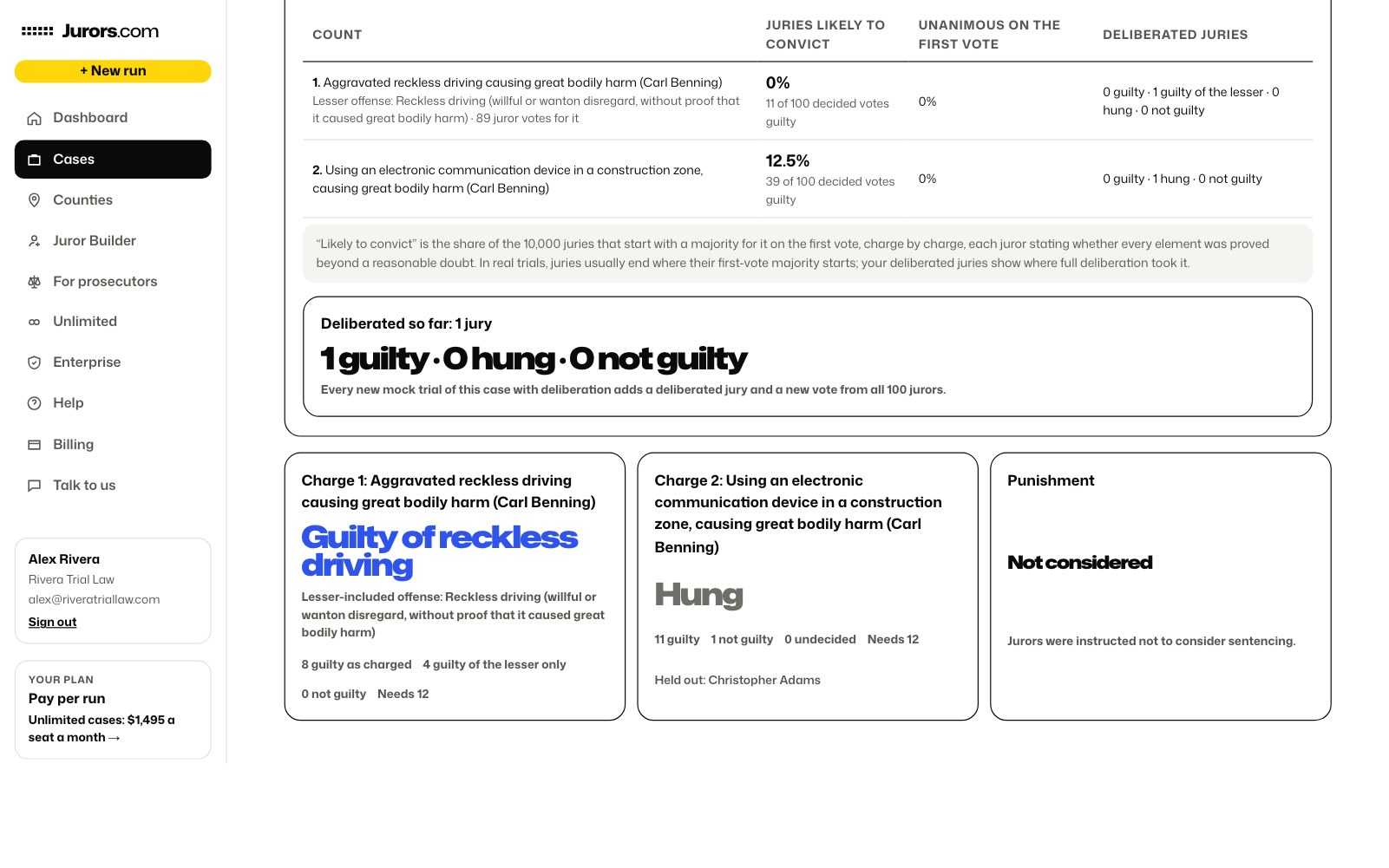
A sample case, run on Jurors.com. A truck driver glanced at his dispatch tablet in a work zone before a crash. Twelve jurors deliberated for three rounds.
On the felony, eight voted guilty as charged and four would convict only of the lesser offense. All twelve agreed on at least the lesser offense, reckless driving. The charge for using the tablet in a work zone hung, 11 to 1.
Before anyone deliberated, all 100 jurors in the county pool voted once: 11 would convict on the felony as charged, and 89 of the lesser offense. So almost none of the 10,000 juries seated from those votes started with a majority for the felony. The twelve in the room went further than the county as a whole.
Tested on real trials, blind.
We gave our jurors recent real criminal trials, with the names changed, without telling them how the cases ended. Here’s how they reasoned.
A driver ran three red lights at 62 mph, then left on foot with his injured girlfriend.
“I think he should answer for the driving, but I don’t believe he left anyone to die.”Juror, 56, stock clerk
Our jurors weighed each charge on its own: guilty on the driving, not guilty of leaving the scene.
A group surrounded a car; one of them shot the driver as he pulled away.
“If he felt threatened, reacted in the moment, it’s not premeditated, not murder. Reckless, sure, but not murder.”Juror, 32, loan officer
The question was intent. Our jurors rejected murder, and most chose the lesser offense of manslaughter.
He says she grabbed his gun and it fired in the struggle. Then he hid the evidence.
“He panicked, got rid of evidence… the prosecution needs to prove he meant to do this.”Juror, 34, moving helper
Most of our jurors held the prosecution to proving intent and would acquit. A vocal minority saw the cover-up as the proof.
Your discovery stays yours
Anonymize it before it ever leaves your computer.
- Switch on “Anonymize before sending” and your documents are read on your own machine. Names, case and report numbers, phone numbers and addresses become labels like “the Defendant” before anything is sent.
- Your case never goes to an outside AI company. Every juror runs on our own servers, and every answer is signed.
- Offices that want everything in-house can run Jurors.com on their own hardware, fully offline.
Start free.
Your first focus group is free. Then pay per run, or cover every attorney in your office.
Talk to us about your office.
Public defender and prosecutor offices, criminal defense firms: office-wide plans, private installs, and pools for any county. Already using Jurors.com? Ask about your account or a run here too.